Waterproofing: the spectrum nobody explains
"Waterproof" on a backpack almost never means what you think it means.
The bag is listed as waterproof. You get caught in rain for twenty minutes. The contents are wet.
This is not a defective bag. It is a terminology problem, one the industry has allowed to persist because the blurry language sells more bags than the accurate language would.
The spectrum
Waterproofing is not a binary. There is no line you cross where a bag becomes waterproof. There is a spectrum of water resistance, from "sheds light mist for a few minutes" to "can be submerged." Many backpacks sold as waterproof sit in the lower half of that spectrum.
The scale has four steps. Splash-resistant is DWR, a Durable Water Repellent treatment that beads water off the surface, degrades with use, and can be restored. Rain-ready adds tighter weaves and coated zippers on top of that. Waterproof, on a backpack, usually means a membrane or interior coating, water-resistant zippers, and taped seams, which is much better in rain but not sealed. Submersible is the only step that means what you picture: a roll-top bag with welded seams and no zippers, built for kayaking and the like.
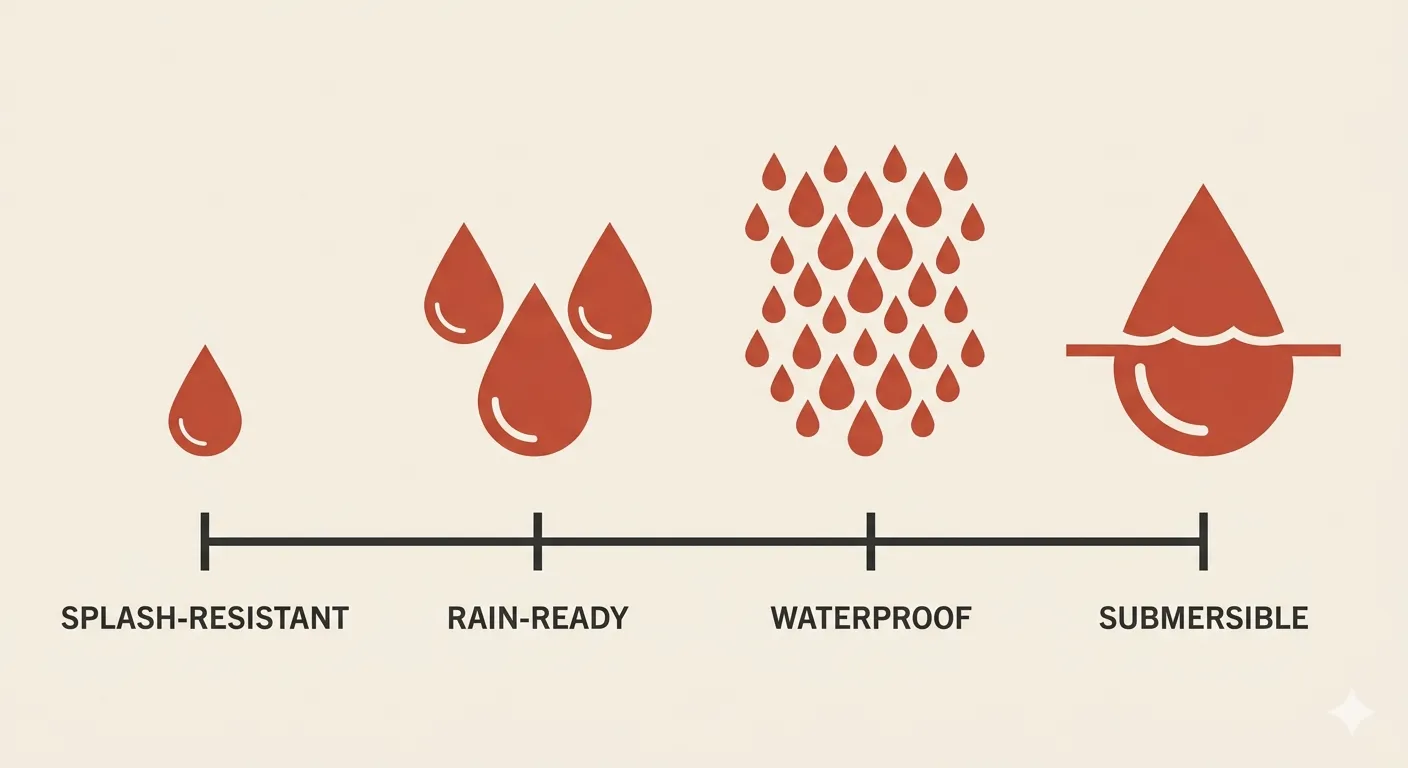
How the coatings and laminates are built is in fabrics.
Where water gets in
Zippers
Standard YKK zippers have no water resistance. YKK AquaGuard zippers are water-resistant: they resist splashing but allow water through under sustained pressure. Fully waterproof coil zippers are the only option that seals. A bag with AquaGuard zippers and a waterproof shell will have a wet main compartment after being left in heavy rain for thirty minutes if the zippers face the sky. Zippers covers the types.
Seams
Every seam is a needle hole, and taped seams close it. Bags marketed as waterproof often tape the critical seams but not all of them. The seam at the bottom of the bag, the one that sits in puddles when you set it down, is the one that matters most and is sometimes left untaped. The seam is a compromise tells why.
The back panel
Sweat from the inside rather than rain from the outside. No waterproof construction solves this. A bag that keeps rain out also keeps moisture in, which is its own problem on a hot day.
Hydration systems
A bottle or reservoir can wet the contents from the inside. Waterproofing around hydration systems covers that case.
What the rating system means
Hydrostatic head measures how much water pressure a fabric can resist before leaking, in millimeters. 1,500 mm is the minimum considered waterproof for light rain. 5,000 mm handles moderate rain. 10,000 mm handles sustained heavy rain. Bags marketed as waterproof often fall in the 1,500 to 5,000 mm range. These numbers are for the fabric only, not the zippers, not the seams.
IP ratings pair a dust digit with a water digit, and a rating with no dust test is written IPX. For water: IPX4 resists splashing. IPX5 resists water jets. IPX7 means submersion to 1 m (3 ft) for 30 minutes. If a bag claims to be waterproof and lists no standard rating, you can't check the claim.
What keeps your contents dry
Waterproof fabric with taped seams and water-resistant zippers handles day-to-day rain. It will not handle being left in heavy rain for an extended period, a sustained downpour on the zipper face, or submersion.
A rain cover covers the whole bag, zippers included, so it protects where the label stops. A waterproof bag liner, a lightweight drybag inside the main compartment, protects contents from moisture coming from any direction, and works in any bag. The cheap fix has the prices.
Do not pay a big premium for "waterproof" on a bag you will use in a city. Pay for quality construction and add the right protection layer for the conditions you meet.
Find the right bag for your trip.
Our quiz considers your trip length, climate, activities, and preferences to recommend bags that actually fit how you travel.
Take the bag finder →