Travel-specific features
Luggage pass-through systems
What the pass-through sleeve does, and what to check before you trust it with a loaded bag.
The hook
Pulling a roller through a long terminal with a loaded backpack on your shoulders is a different experience from sliding the backpack onto the roller's handle and walking without it. A sleeve on the back of the bag makes that possible.
What is it
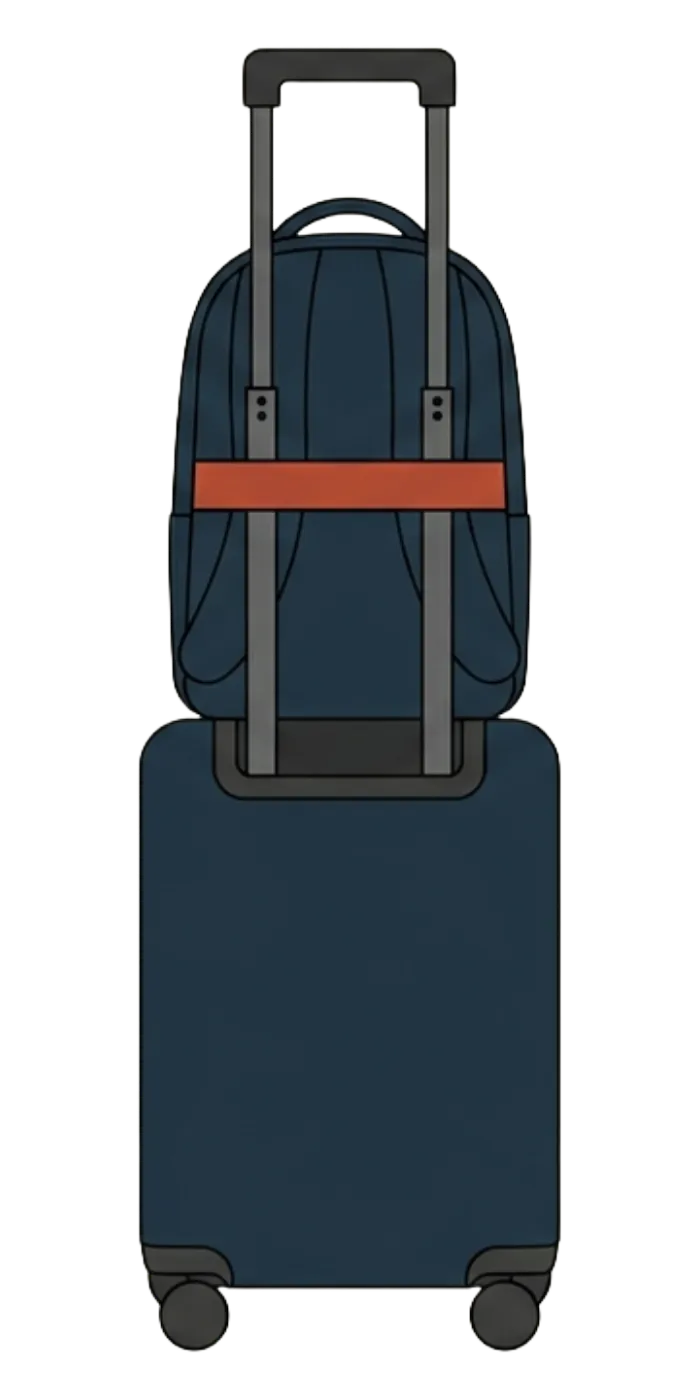
A luggage pass-through (also called a trolley sleeve) is a horizontal sleeve on the back of the bag that slides over the handle of rolling luggage. When the bag is on the roller, the roller carries both, freeing your hands and shoulders. Good versions are reinforced and wide enough for varying handle widths. Cheap versions are narrow and untested under load.
Why it matters
Carrying a loaded backpack while pulling rolling luggage puts an uneven load on one shoulder and your back over long terminal walks. The pass-through takes that load off your body. The weight still sits on the roller's handle and wheels, so check that your roller can take it. The sleeve also keeps the bag from bouncing against your back and from sliding off the handle.
How to spot it
Measure your roller's handle across both posts and check the sleeve is wider. Handles differ by 3 to 5 cm (1 to 2 in) between brands, so a sleeve that fits one roller can miss the next. Test it on your own handle if you can. Look where the top and bottom edges of the sleeve meet the back panel: you want bar-tacks (short, dense blocks of zigzag stitching) or a second row of stitches, not a single line. These spots take a lot of shear force when the roller moves over bumps. A loose bag swings on the handle, so compression straps help, and packing order keeps the weight low and centered.
When you don't need it
If you rarely travel with rolling luggage, a sleeve adds structure and weight you won't use. If you hand-carry your bag on transit, it matters less. For laptop screening, see TSA-friendly design.
Key takeaways
- The pass-through sleeve moves the backpack's weight off your shoulders and onto the roller's handle and wheels. Over a long terminal walk, that is the whole feature.
- Measure your roller's handle against the sleeve width, and look for dense bar-tack stitching where the sleeve's ends meet the bag. Cheap versions fail under the forces of a loaded roller moving over bumps.
- This feature is for trips with a roller. On a carry-on-only trip it adds little.
- Test the sleeve with your actual rolling luggage handle before buying. Handle widths differ by 3 to 5 cm (1 to 2 in) between brands, and a sleeve 1 cm (under half an inch) too narrow fails the whole feature.
Quick poll
When you travel, what's your typical setup?