Specialized use cases
Sling bags: a different object, not a smaller backpack
The strap geometry and access pattern are the point, not just the volume.
The hook
A sling is not a smaller backpack. It's a different object solving a different problem, and evaluating it like a backpack is how you end up with the wrong one.
What is it
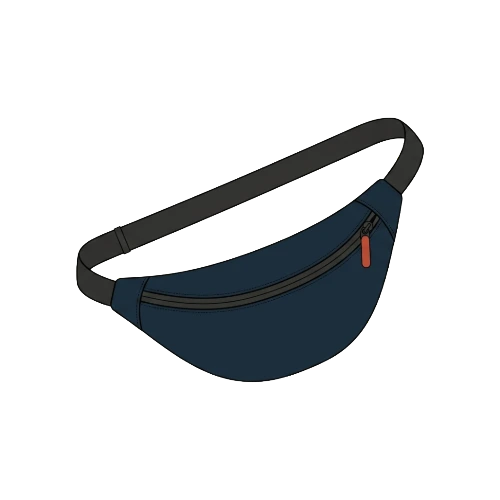
A sling is a single-strap bag worn diagonally across the body, typically 1–10L, sitting on the back, hip, or chest depending on positioning. The strap is wider than a messenger bag's and shorter than a crossbody's, and the bag is designed to rotate quickly to the front for one-handed access. Slings emerged from cycling and tactical contexts and went mass-market in the last decade. They occupy a category distinct from chest packs (smaller, fixed forward), fanny packs (waist-mounted, no shoulder strap), shoulder bags (typically two-strap or wider strap, vertical orientation), and small backpacks (two straps, no rotation pattern).
Why it matters
The sling solves a specific carry problem: high-frequency access to a small set of items, with the bag staying on the body throughout. Phone, wallet, keys, AirPods, water bottle, sometimes a small camera. The rotation-to-front access pattern is faster than removing a backpack: a few seconds versus thirty. The cost is asymmetric load on one shoulder, which is fine at low weight and punishing above a threshold (typically 3–4 kg sustained). Buying a sling and treating it like a small backpack, packing 6 kg of laptop and water into it, is the most common mistake. The bag will physically fit it; your shoulder will not tolerate it.
How to spot it
Strap width and padding determine sustainable comfort more than any other variable. A 25 mm strap with no padding is a 30-minute bag at most. A 50 mm padded strap can carry a properly sized load for a full day. Check the strap-to-bag attachment: slings stress this junction more than backpacks because all weight goes through one point. Look for bar-tacking, double stitching, or hardware reinforcement. Volume claims to check: the bag should fit your reference items (phone + wallet + keys + bottle) without strain. Single-zipper vs. wraparound zipper changes the access pattern a lot. Wraparound is faster; single is more secure.
When you don't need it
Anything over 3–4 kg of contents. Long carry days where shoulder asymmetry will accumulate. People for whom one-shoulder loading causes pre-existing back issues. Use cases where a small backpack with a quick-access pocket would do the same job with bilateral load distribution.
Key takeaways
- A sling is a different object than a small backpack. The strap geometry and access pattern are the point, not just the volume.
- Strap width and padding determine sustainable comfort. Below 50 mm, comfort is duration-limited.
- The asymmetric load is fine at low weight and punishing above 3–4 kg. Pack accordingly.
- Slings shine for high-frequency low-weight access. They fail for sustained heavy carry.
Quick poll
What do you carry when you don't carry a backpack?